Why Goat Milk? Kabrita Goat Milk-Based Infant Formula Review
This post was written as a paid collaboration with Kabrita. As always, all opinions are our own!
From easier digestion and softer stools to immune-supporting ingredients and impressive safety standards-there's a lot more to goat milk-based infant formula than we initially thought. In this post, here's what you need to know about Kabrita.

Me (excitedly telling everyone I see): "Guess what? I'm going to The Netherlands to visit some goats!!"
Everyone: "Excuse me, did you say goats???"
Me: "Yes, Kabrita, Dutch makers of goat milk-based infant formula have recently gotten the green light from Health Canada and the FDA to launch in North America, so they've invited select healthcare providers across the pond to learn more about it."
Literally Everyone: "Okay, but why goat milk?"
This was an actual conversation we both had on repeat - everyone we talked to was curious about why goat milk might be used to make infant formula. We totally understand the curiosity, because we wondered the same thing.
"Is goat milk just a trend in the infant formula world or is there any merit to using it as an alternative base to cow's milk?"
As your online dietitian besties on all things baby + toddlers, it was our duty to investigate. We know with so many options on the market, it can be overwhelming for parents to decide what formula to feed their babies. So we flew seven+ hours to Europe to find out!
SPOILER ALERT: we spill all the details below, but as it turns out, yes- goat milk-based infant formula is naturally more similar to human breast milk than cow milk-based infant formula. As a result, it ends up being easier for babies to digest and tolerate! Breast milk always has been and will forever remain the gold standard for infant nutrition. As such, we love learning how formula companies are continually innovating to find closer matches to breast milk!
Jump to:
What is Kabrita?
Kabrita is a trusted brand of goat milk-based formula for infants and toddlers. While they may be new kids on the block here in North America (just launched in Canada in January 2025!), Kabrita is anything but new globally. They've been nourishing little ones around the world for decades.
Until recently, parents in Canada and the U.S. had mostly two bases when it came to infant formula: cow's milk, and soy. And while that works for many babies, it's not always the best fit for all. The exciting news is that families now have more choices.
But here's the real reason we're buzzing about Kabrita: the science behind goat milk. As we said, it's actually closer than cow's milk to human breast milk in several key ways.
Don't worry, we're going to unpack all of this (and more) below.
What makes goat milk-based infant formula unique?
When protein matters
Let's talk protein-this part gets a little geeky!
One of the most exciting things about goat milk-based infant formula, is how the protein composition more closely mirrors that of human breast milk especially in comparison to cow's milk-based formula-making it naturally gentle and easier for babies to digest.
Here's why:
First - a primer on milk proteins. The two major proteins found in all mammalian milks are whey and casein.
The whey-to-casein ratio in Kabrita's infant formula is 60:40, which is the same ratio found in mature breast milk. That matters, because this balance affects how the proteins move through your baby's digestive tract.
The result? A protein composition that's closer to what babies are naturally built to digest, which may explain why some babies experience fewer tummy troubles, less constipation, and softer stools on goat milk-based infant formula.
Goat milk also contains more of the easier-to-digest beta casein and less of the harder-to-digest alpha casein-which is the predominant casein in cow's milk. This protein difference means goat milk forms softer, looser curds in the tummy-making digestion easier and often resulting in less discomfort for babies.
Digestive comfort and tolerance
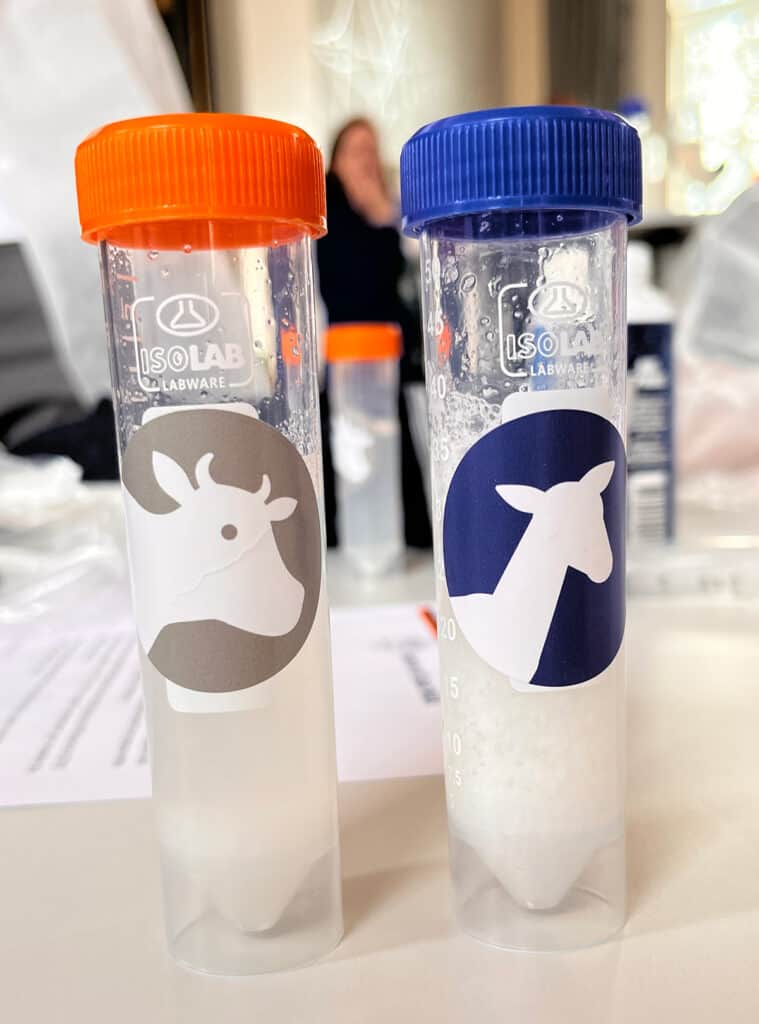
It's one thing to be naturally closer to breastmilk, but does it really matter? This study actually showed that after two hours, goat milk-based formula and breast milk were already halfway digested-around 50%-whereas cow milk-based formula was only about 35% digested. That's a pretty big difference for tiny tummies and can make all the difference when it comes to digestive comfort.
Kabrita's infant formula also contains SN-2 palmitic acid which can ultimately help with fat and calcium absorption, promote a healthy gut microbiome,, softer stool, and reduced infant crying (yaay). Another bonus is that SN-2 palmitic acid can support your baby's bone health early in life by enhancing calcium absorption.
But there's still more. In this study, when babies were switched specifically to Kabrita, their gastrointestinal related symptoms decreased dramatically. Since a picture tells a thousand words, just look below. As you can imagine, having an infant tolerate their formula would make the world of a difference for caregivers!
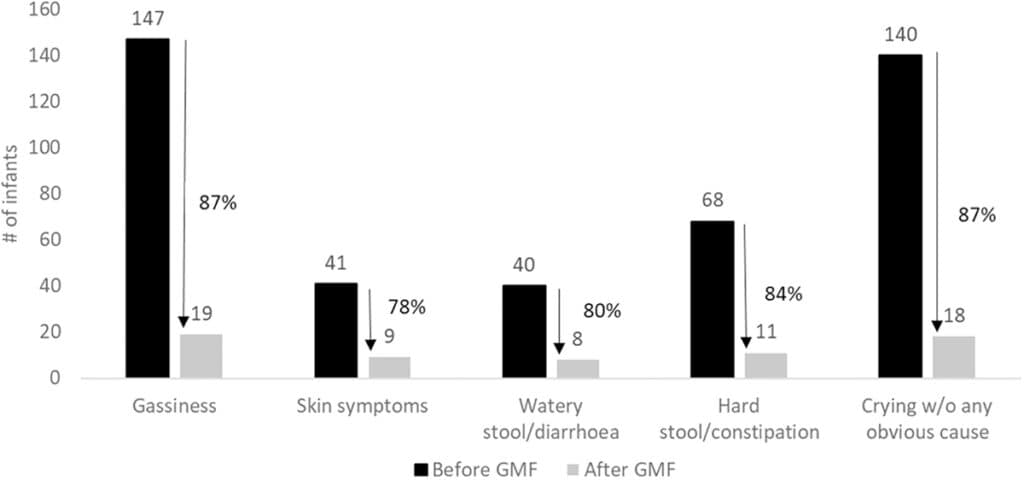
Source: https://onlinelibrary.wiley.com/doi/full/10.1002/hsr2.70448
Naturally supports gut health and immune function
Oligosaccharides are short chain carbohydrates that resist digestion until they reach the large intestine. At this point, they provide several health benefits!
- Oligosaccharides work as prebiotics - meaning they provide food to help grow and strengthen the beneficial gut microorganisms.
- Oligosaccharides work as decoy receptors, preventing pathogens from entering the body.
- Oligosaccharides improve gut barrier function by tightening the junctions in between the cells lining the gut.
- Oligosaccharides act as immune system modulators. In short, they strengthen the baby's immune system to better fight off pathogens.
- Some oligosaccharides are involved in brain development.
Currently, over 200 oligosaccharides have been identified in human milk. There may certainly be many more left to discover! Human milk oligosaccharides make up the third largest component in breastmilk. There are more oligosaccharides than proteins!
Goat milk has five times more oligosaccharides than cow's milk. Additionally, goat milk has 16 oligosaccharides in common with human milk while cow's milk only has 9 in common.
Farm to Formula - What makes Kabrita stand out
Kabrita has high-quality standards at every step of the production.
All of the goat milk used to make Kabrita's formula is sourced from local Dutch farmers, with whom they've fostered close working relationships. In order to produce high quality milk, each goat gets custom-tailored nutrition to match its own unique needs!

At the factory, there are 90+ safety and nutrition checks that EVERY can needs to pass before it can hit the shelves! We were very impressed with the design of their state of the art facility to maximize safety. As an example, since micro-organisms need water to survive, they've designed a waterless cleaning system so as not to introduce any moisture into the environment.
While the US and Canada do not have robust heavy metal requirements for infant formula, Kabrita complies with all European manufacturing and safety standards, which include strict heavy metal requirements. Furthermore, internal Kabrita safety standards incorporate heavy metal limits that are even more stringent than those of the EU.
While European standards state Cadmium heavy metal content in infant formula may not exceed 20 parts per billion (ppb), Kabrita takes it a step further and ensures their formula doesn't exceed 10 ppb for Cadmium. Kabrita is the first and only goat milk-based infant formula to achieve Clean Label Project's three strict certifications: Purity Award, Pesticide-Free Certification, and First 1,000 Day Promise Certification. Additionally, they're the first infant formula company to proactively make heavy metal testing data publicly available. Simply enter the lot code found on the tin to trace your Kabrita formula on their website.
Who is goat milk-based formula for?
After traveling all the way to The Netherlands, meeting the goats (yes, seriously goats), and diving deep into the research and production practices behind Kabrita, we walked away feeling excited. Goat milk-based formula isn't just a passing trend-it's a meaningful first-choice option for all healthy term infants and can better meet the needs of some babies whether they are being combo fed or using formula exclusively.
Kabrita's infant formulas have received the formal green light from Health Canada and the FDA, meaning they meet the rigorous safety and nutritional standards for infant formula in North America.
But this is important….
While Kabrita is suitable for most babies, it's not intended for babies with a diagnosed cow's milk protein allergy, as goat's milk proteins can still trigger a reaction in these little ones. If you're unsure whether goat milk-based infant formula is right for your baby, it's always a good idea to chat with your healthcare provider or dietitian.
Bottom line?
As dietitians and moms, we're so glad to see more choices becoming available for families. Because when it comes to feeding your baby, one size definitely doesn't fit all.
Kabrita has prepared a Formula 411 guide for parents. Download it below to learn more about infant formula including how much to feed your baby and what makes goat milk-based formula unique!