
9 Things to Say When Your Toddler Won’t Eat Their Meal
Dietitians share key phrases that will help your toddler feel comfortable and confident at the table and able to learn to like new foods.

Picture this: You've powered through a full day-whether that's at work, wrangling kids, or both. You come home, make dinner (bonus points if you did it while bouncing a crying baby on your hip or narrating a play-by-play to an antsy toddler), herd everyone to the table, get drinks poured, napkins handed out, forks in the right hands…
You finally sit down, take a deep breath, and-
"Yuck. I'm not eating that."
Cue the inner eye roll, the silent scream, and the overwhelming urge to question all your life choices.
Sound familiar? We're willing to bet it does. And here's the thing: not even dietitian moms are immune to picky toddler protests. Oh yes, our kids have turned up their noses at lovingly prepared meals, too.
But here's the good news: we've been there-both as moms and as nutrition pros. We've gathered tried-and-true, evidence-based (but still real-life doable) strategies to help you tackle those dreaded words "I'm not eating that" with confidence.
Today we're going to cover:
- A 'cliff notes' version of how to build a strong foundation for positive family meals
- Nine responses you're going to want to keep in your back pocket for when your toddler doesn't want to eat what you've served
Now, let's get to building the backbone of positive family meals!
Bite-Sized Takeaways
🧱 Toddler meal rejection is developmentally normal
🔥 Family meals are important for young children, from the start and throughout childhood
🥣 Saying "do you want a bite" is typically not effective
🥣 Parents can download a free handout to keep on their fridge
‼️ Parents can invite food curiosity with specific questions
SUMMARIZE AND SAVE THIS CONTENT ON:
The Foundation of Positive Family Meals
At its core the foundation for creating positive family meals comes from the Division of Responsibility in Feeding. If you've been here a while you may already be familiar with this concept. If you're new here, no problem - it's one of our favourite things to teach parents of young children about.
The Division of Responsibility in Feeding is a concept developed by Ellyn Satter, a registered dietitian and family therapist. It outlines clear roles for both caregivers and children when it comes to feeding and eating. The goal is to support a healthy relationship with food and reduce mealtime stress.
Here's the main idea:
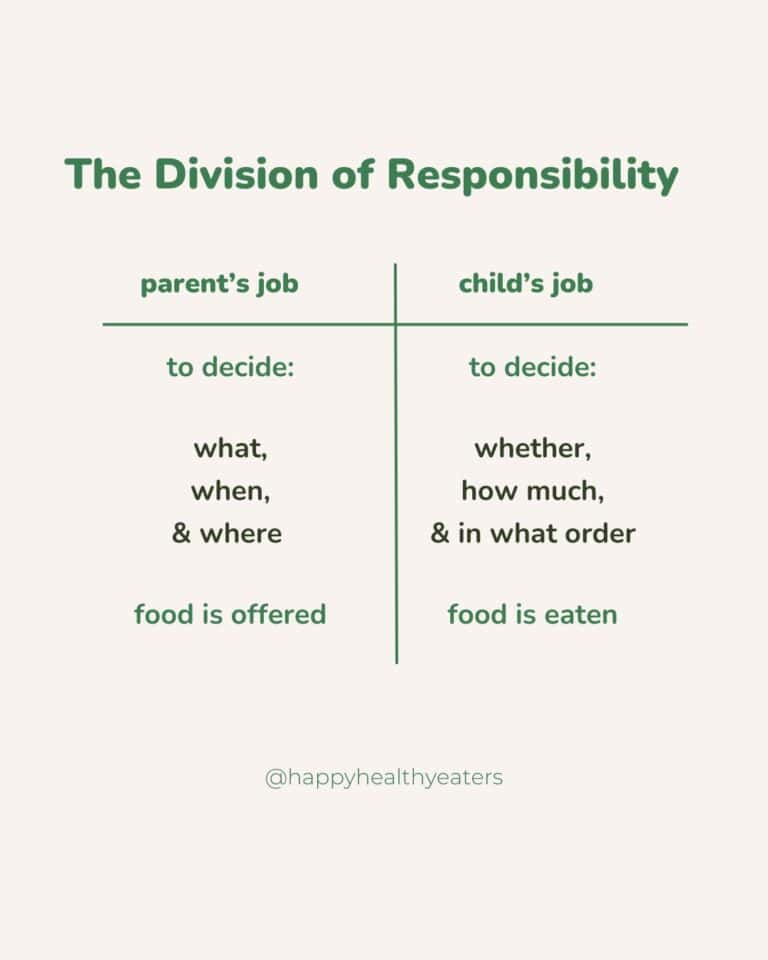
Essentially, YOU decide what food is served, craft a meal and snack schedule, choose the location food is eaten, and YOUR CHILD decides if and what they're going to eat from the selection you've offered.
When it comes to picky eating there's one more vital part of this concept - when planning your menu it's crucial to respect where your child is at in learning to eat different foods and ensure there's at least one accepted food at each meal.
It may sound simple but, when this concept is put into practice we see profound changes follow:
-
- Kids start to feel a sense of safety seeing at least one food they feel confident about on the table and their stress around the meal goes down.
-
- There's no short order cooking for you, which will decrease your stress too. You've probably already noticed that when you're less stressed and more confident, your kids will pick up on that energy and mirror it.
All in all it's the opposite of a vicious cycle! Instead of adding to meal time stress, the Division of Responsibility not only diffuses stress, but also replaces it with comfort and confidence.What we've explained above can be truly transformational for families. We've seen it in action time and time again. If you're feeling like you want to know more about this foundation, as in the 'full meal deal' when it comes to creating meal time experiences that are positive for you and your toddler, along with strategies for nurturing a positive relationship with food, a grocery shopping guide, snack guide and a hands-on food play guide, and MORE then our ecourse Feeding Toddlers Confidently is what you need.

9 back-pocket responses to "I'm not eating that."
Even with the foundations of positive meal times in place there will still be times when your toddler tells you they don't want to eat something you've served. It just comes with toddler territory. That's why we've come up with nine tried and true responses to curb the negativity while fostering open and respectful communication with your child at mealtimes. In all honesty, we use them in our own homes on the regular and they are moneyyyyy.
1. "You don't have to eat it"
It sounds simple, but this response is powerful. Not only does it squash meal-time power struggles, but it also removes pressure surrounding the food in question and meal as a whole (which can be a contributor to picky eating in itself). We call this a win-win.
Remember - not everything on the table needs to be a hit for your toddler. If you've done your part to serve at least one accepted food, you can relax knowing that your child has something to eat they feel comfortable and confident with.
2. "What would make this better?"
We love this one because it focuses on collaboration between you and your child. Think of it as extending an olive branch to your child while still holding your boundary of the meal menu.
Their responses to this question may surprise you too. Sometimes a change in temperature (colder or hotter) or even a different utensil (a spoon versus a fork) can make a world of difference to your little one.
Jessica has memories of being served macaroni and cheese with a fork, but it just didn't feel right until she got a spoon in her hand.
3. "What does it taste like?"
Shift the spotlight to exploring the food. It instantly changes the vibe-and shows your little one that you're genuinely curious about what they think.
If taking an actual bite is still a no-go, try asking, "What does it look like? What does it smell like? How does it feel?" These questions make the experience feel safer for them, while still inviting them to interact with the food. Remember: every positive sensory experience-seeing, smelling, touching-is a baby step toward tasting.
4. "You're learning to eat x food"
The language we use when we speak to our kids influences their internal dialogue. This is as true with feeding as it is in many other parenting situations.
When a child says "yuck" it shows that they've already made their mind up about a particular food. Using this phrase helps encourage your child to keep the door open to trying foods in the future, even if they're not quite ready to do it today.
5. "Sometimes we eat your favourite food, and sometimes we eat my favourite food"
Around here, we see the dinner table as more than just a place to fill hungry bellies-it's a classroom for life skills. And with this simple phrase, the lesson of compromise takes the spotlight.
That's one reason meals like our veggie-loaded pasta sauce work so well. Pasta might be your child's favourite, while a roasted, veggie-packed sauce might be yours-and serving them together lets everyone win.
When kids see a parent genuinely enjoying a food, they're more likely to give it a try… and eventually enjoy it themselves. So go ahead-serve up your favourites with a smile. You're teaching way more than you think.
6. "Our next eating time will be at XYZ"
By letting your child know when the next eating time will be, you are providing an opportunity for them to gauge their hunger and learn how much they need to eat to sustain their bodies between eating times. This phrase will be particularly effective if you stick to a general meal schedule or rhythm day to day and ensure there's at least one accepted food at each meal for them to fill up on.
7. "Can we add a condiment?"
If you haven't already noticed, most kids LOVE condiments. And guess what? As moms and dietitians we do too! Here's why:
-
- Condiments can offer a sense of familiarity and safety to a meal increasing the likelihood kids will actually eat what's on the table.
-
- Dipping food is fun! Fun is a key element to successful meals for toddlers as it removes pressure and lightens the mood.
-
- Condiments can be a source of nutrients toddlers need. Some of our favourite nutrient-packed condiments for toddlers are edamame dip, black bean dip, tzatziki, good ol' ketchup and chia berry sauce.
Plus, similar to response #2, asking for your child's input here allows them to feel involved and in-control of what goes on their plate and in their mouths.
8. "Thanks for letting mama know"
Just like adults, toddlers want to feel heard and this response is clutch for just that. We've been pleasantly surprised many times at how this response diffuses meal time power struggles with no further discussion needed.
When you have a solid feeding framework in place, it enables you to relax and confidently move on with enjoying your meal together instead of feeling stressed that you need to find something, anything your toddler is willing to eat!
9. "I can see you're not interested today. Maybe next time."
Similar to response #8, this one communicates to your toddler that you understand how they are feeling in the moment, while keeping the door open to trying XYZ food in the future.
A couple more things to keep in mind with these back-pocket responses:
-
- We know different strategies, phrases, and approaches work better or worse for different kids, and that YOU know your child best. Our suggestion is to pick 2-3 of these phrases that resonate with you, memorize them, and try them out a few times!
-
- We also know in the heat of mealtimes it can be tricky to recall phrases like the ones above, especially if they are new to you. That's why we created this printable document with all nine responses. Print it and stick it on your fridge or a kitchen cupboard for an easy reminder when meal times are getting a little too heated.
Put This On Your Fridge!
It's one thing to read these nine phrases and think "ooo, that's a good one - I'll use that next time!"
It's another thing to actually remember what the phrase is!
Which is why we've created a handy one-pager you can download to tape to your fridge or post near your dining table so you can actually put these phrases to use!
Enter your email below and we'll send you the printable.
Where can I get more support for feeding my toddler?
We truly believe that parenting toddlers (which includes feeding!) can be magical. But, we also know it can be heavy, chaotic, stressful, exhausting and everything else in-between.
That is why we created our course Feeding Toddlers Confidently - to be a place where parents of children ages one to eight years of age can feel validated in their struggles (and wins!) and learn evidenced-based strategies (like the ones we reviewed today!) that will support them in feeding their kids. Because feeding is parenting.

Thank you for this! We have used a number of these phrases. I do have a questions though regarding food waste. I often won't force my toddler to finish his plate, however I struggle with the phrase "you don't have to eat this" beacuse the food often just goes to waste. Do you have any tips of keeping a stress free table environment while also reducing food waste?
Great question! We definitely strive to reduce food waste as much as possible in our homes too!
1. Consider serving meals "family style" and allowing your children to serve themselves. More on that in this blog post.
2. Here's another post focused on babies about reducing food waste.
3. If you want to pre-plate, only place a tiny amount of food in case it doesn't get eaten.
4. One mindset shift has helped me be okay with a little bit of food waste in the name of helping our kids learn to like new foods. If you think about arts and crafts, lots of craft supplies get used (and discarded) but we don't consider it a waste because kids are learning how to get better at art!