How Safe are the Fruits and Veggies in my Child's Lunch?
Worried about pesticides on the fruits and veggies in your child's lunch? Learn what pesticide residues really mean and how safe produce is for kids. Spoiler: you can relax.
This post may contain affiliate links.
This post was written as a paid collaboration with CropLife Canada. As always, all opinions are our own.
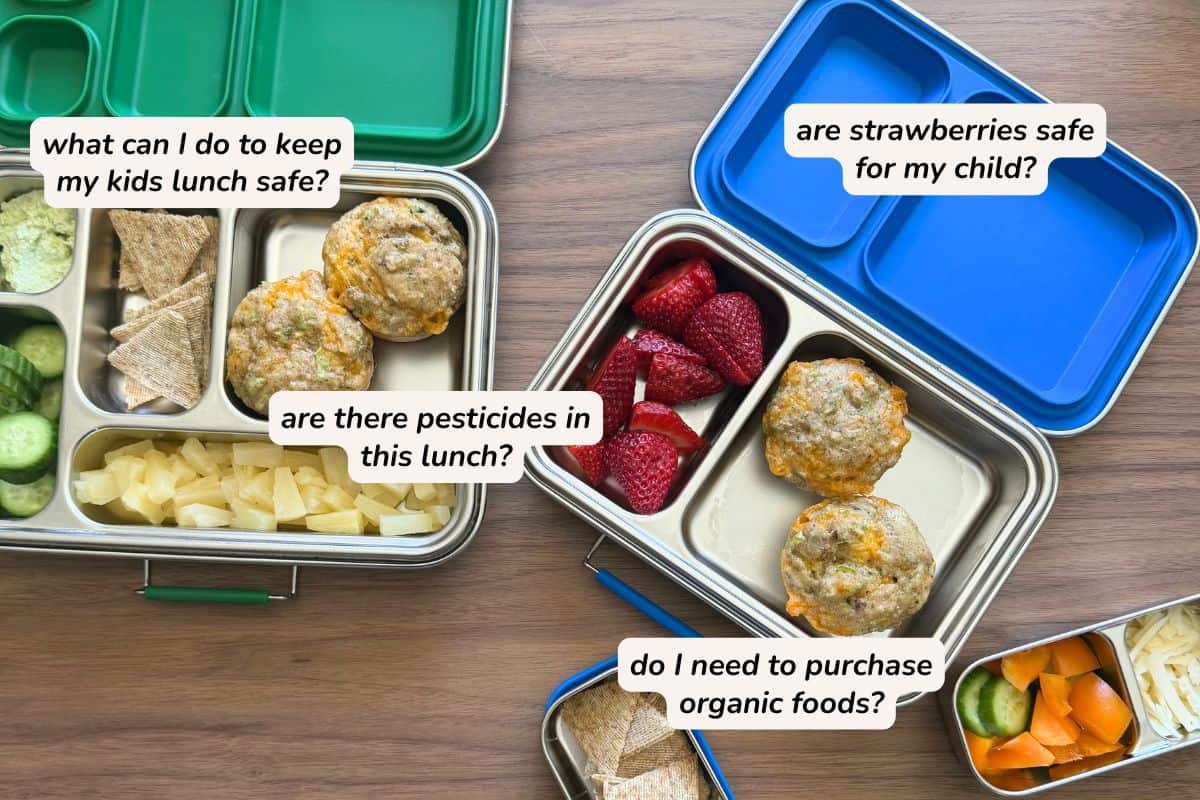
It's a busy day, like every day: you fed your kiddo boxed cereal with this chocolate banana smoothie this morning and then packed strawberries for their lunch. But then you saw a social media headline about strawberries and pesticide residues, and had a mild panic attack.
Let's get a few things straight off the hop.
Both conventional and organic farming use pesticides. Did that surprise you? Organic isn't a pesticide-free category, the list of approved pesticides is just different. Importantly, the use of all pesticides is highly regulated, and strict limits are in place to ensure health and safety.
A pesticide residue being present is not the same as a residue being harmful. Modern testing is so sophisticated that pesticides can be detected at parts per billion (that's less than one teaspoon in an Olympic sized swimming pool).
So here's the honest version: Food safety is important, but scary social media headlines have many parents worrying about the wrong things. When it comes to pesticide residues, the produce you pack for your child's lunch is safe to eat. While there are a few simple things you can do to reduce food safety risk, having to make a decision about organic vs conventional produce, isn't one of them.
So what should parents actually pay attention to? What does the Dirty Dozen list really tell us? And is organic food worth the extra cost? Let's dig into what the science tells us, so you can feel more confident about what's going into your kiddo's lunchbox.
Bite-Sized Takeways
🍎 Both organic and conventional farming use pesticides
😀 Detectable pesticide residues do not automatically mean a food is unsafe
🙌 99% of fruits and vegetables tested in Canada meet established pesticide residue limits
‼️ Parents don't need to use The Dirty Dozen to help with grocery shopping
🔄 Both organic and conventional fruits and vegetables can be part of a healthy diet; parents can choose what fits their family's budget and preferences
SUMMARIZE AND SAVE THIS CONTENT ON:
Jump to:
- Bite-Sized Takeways
- What does "pesticide residues were detected" actually mean?
- Should I be worried about the Dirty Dozen list?
- Is organic produce safer for my child?
- Is organic produce more nutritious?
- Risks that actually deserve your attention: food safety in a lunch bag
- The bigger picture: the real risk is kids eating too few fruits and vegetables
- Your FAQs answered
- Our favourite fruit & veggie recipes:
What does "pesticide residues were detected" actually mean?
Let's talk about what actually happens when a pesticide residue shows up on produce.
First, you should know that in Canada, Health Canada (our department that regulates products and manages health risks) evaluates the safety of pesticides before they're approved for use. This includes how much residue can safely remain on the food we consume. This safety margin takes into account all Canadians, including vulnerable populations like pregnant people, infants, and children.
From there, Health Canada sets a maximum residue limit (MRL) for each pesticide. Think of an MRL as a regulatory line: it's the highest amount of residue that's legally allowed to remain on a food when the pesticide has been used according to the label. Importantly, it's set at least 100 times lower than the amount that could cause harm.
But the safeguards don't stop there.
The Canadian Food Inspection Agency (CFIA) regularly tests foods for pesticide residues. In the 2020-21 monitoring data, over 99% of fresh fruits and vegetables grown and imported in Canada had residue levels below the established MRLs. There's a lot to celebrate there!
So what about that <1%?
Being above an MRL is a regulatory issue, but it isn't the same as being a health risk. Because there is a 100-fold (minimum) safety factor built-in to the MRLs, these residues still remain below the amount considered safe.
What happens next? If the CFIA detects an MRL exceedance, they refer the findings to Health Canada for assessment. Based on Health Canada's findings, the CFIA then has the authority to take enforcement actions, which can range from holding shipments to initiating a full public food recall.
Should I be worried about the Dirty Dozen list?
At some point in your food-parenting journey, you've probably come across the Dirty Dozen list. The name alone is enough to make a parent worry about every morsel of food they pack in their kids' lunch! Fortunately we've dedicated an entire blog post about why we ignore this list!
The Dirty Dozen is an annual list published by the Environmental Working Group (EWG), which ranks fruits and vegetables based on factors such as how often pesticide residues are detected and the number of different pesticide residues found.
Here's the catch: the list does not tell you whether a food is safe or unsafe to eat.
Here's the other catch: the fruits and vegetables listed each year report residues that are FAR below the minimum threshold level that could cause harm to human health.
And a third catch: remember how both conventional and organic produce can be grown with the use of pesticides? The EWG only tests for pesticides used in conventionally grown produce and conveniently leaves out testing for pesticides used in organic production. Their concluding recommendation is to choose organically grown foods on this list, but who's to say the organic counterparts are any "safer" without any testing?
So, should parents really be worried about the Dirty Dozen?
No! A list like this shouldn't add another layer of stress to feeding your family. At the end of the day, getting more fruits and vegetables onto the plate matters a whole lot more, since we know kids struggle to eat enough of them as it is!
Is organic produce safer for my child?
From a safety perspective, organically grown produce is not superior to conventional produce. We've shared this before and we'll share it again: organic farmers also use pesticides.
Organic producers can use pesticides from an approved list, which are usually naturally derived. But whether a pesticide is naturally derived or synthetically produced, doesn't impact its safety (remember, all are highly regulated!). For example, whether an apple is grown organically or conventionally won't impact how safe it is to eat, but how it is handled, shipped, and stored can!
Is organic produce more nutritious?
Outside of safety, you might be wondering if organic produce is more nutrient rich. Afterall, we are dietitians and we're here for the nutrition!
There's no consistent evidence that organic produce is significantly more nutritious than conventionally grown produce. The nutrient content of a particular food can vary for all kinds of reasons, including soil, growing conditions, variety, ripeness, and when the food was harvested.
If you love buying organic and it works for your family and your budget, there's absolutely nothing wrong with choosing it! But it's important to know that you're not reaping a safety or nutrition benefit.
Risks that actually deserve your attention: food safety in a lunch bag
In our opinions, food safety is a greater risk that deserves more attention! Food safety' means handling, preparing, and storing food in ways that prevent people from getting sick.. One example of keeping food safe is avoiding bacteria growth that could lead to foodborne illness. Since bacteria need a food source, water, the right temperature, and enough time to reproduce at levels that can make a person sick, we can work on managing those risk factors.
Let's look at how you can reduce the risk:
Presence
First of all, bacteria have to be present in order to cause a problem! Fruits and veggies can pick up bacteria in the field while growing, during transport, and at the store while being handled. So your first step should be to wash them while rubbing under cool, running tap water. For rinds/peels with ridges or indents (such as melons or avocados), scrub with a brush as the bacteria like to make a home in those cozy spots. Oh, and skip any rinses or cleaners marketed for washing fruits and veggies; research shows good old H2O does the best job!
Water & Temperature
Bacteria need water to grow. The outside of the produce is fairly dry, but as soon as you cut it open, you've exposed moist, nutrient-rich flesh! This is why cut fruits and veggies need to stay refrigerated and dried fruit can sit in your cupboard.
To keep your child's lunch safe, make sure pre-cut fruits and veggies get packed alongside ice packs in an insulated bag.
In this 2011 study, researchers in Texas analyzed lunches sent from home for preschool children. Only 1.6% of perishable items were recorded to be in a safe temperature, and that was 1.5 hours before lunchtime!
Time
Jessica has taught her kids a saying for eating a packed lunch: "fresh food first!" They know it's an important food safety measure to eat the foods that require refrigeration sooner than later. Unless you have a large quantity of ice packs weighing down your child's backpack, fresh food is not likely going to stay at a safe temperature for more than a few hours. If your child's care center or school offers snacktime, teach your children to eat their fresh cut produce first and save their non-perishable snack for the afternoon.

The bigger picture: the real risk is kids eating too few fruits and vegetables
Let's take a step back for a moment and remind ourselves why consuming fruits and veggies is so important! Here's a non-exhaustive list of how your child benefits from eating plenty:
- Fibre - increases and prolongs feelings of fullness, promotes the growth of beneficial bacteria in the gut, prevents constipation
- Vitamin C - needed for immunity and to build collagen and bones
- Vitamin A - also needed for immunity as well as eye health
- Folate - needed for energy production and healthy red blood cells
- Potassium - balances out sodium for cardiovascular health
- Hydration - produce is often made up of a lot of water, so it can also be hydrating!
Eating plenty of fruits and vegetables has long-term benefits, too! This research paper shows for each daily serving of fruits and vegetables (up to a max of five), the risk of death from any cause decreases 5%! Did you do the math? That means eating five servings or more each day amounts to a 25% risk reduction!
It's clear that the science on the benefits of eating lots of fruits and veggies far outweighs any health and safety risk from exposure to minute levels of pesticide residue.
Sometimes we need to get back to the basics - serve those fruits and veggies (regardless of how they were grown), consider good food safety when preparing and packing them up, and help your children cultivate a true enjoyment for them!
Need to put this into practice? Here are some of our favourite fruit and veggie forward recipes we love: veggie loaded pasta, carrot and zucchini muffins, fruit pizza and this chia berry compote that we put on pretty much everything!
Your FAQs answered
In case you have a few more questions, or you're the type to just jump to the FAQ section, we've rounded up the top questions we get!
Yes, it would remove some residues. BUT it's kind of a moot point because a) pesticide residues are incredibly low to non-existent to begin with and b) you'll want to wash produce anyhow from a food safety standpoint!
Fruits and veggies grown to organic certification standards are more expensive in part because it's not possible to grow as much on the same amount of land. Additionally, there's a cost to certification, the farms are smaller, and there's a limited supply compared to demand.
It's important to know what you're getting for that higher price. What you aren't getting is a pesticide-free product, since organic producers also use pesticides. ou also aren't getting more nutritious produce, since conventionally and organically grown produce has consistently been shown to be equally nutritious.
What you are getting is a food that was grown according to Canadian organic standards. So if those standards are important to you, and the cost is within your budget, then go for it!
Here's a real life example: When you prepare our recipe for Indian Sheet Pan Dinner using organic ingredients, be prepared for a markup!
When made with conventional ingredients, this recipe costs $12.06.
When made with organic ingredients, it came to $19.00 - a 58% markup!
Note: we used Canadian prices reflected on October 20 2025 at local retailers.
We definitely encourage you to keep the peel on your apples (and potatoes, and pretty much any other edible peel)! The peel is where a good chunk of the fibre lives-that's why we kept it for this delicious applesauce cake that you must make! Additionally, many of the nutrients are found just under the peel.